Sanday, Orkney. One of the islands. See it at ://www.sandayorkney.co.uk/ It is small - 19 square miles - with some 550 people, see ://www.sanday.co.uk/. A very small community, accessible by yet another ferry.
See the beach at http://www.youtube.com/watch?v=GejvYv5jqlQ/
And the lighthouse, at http://www.youtube.com/watch?v=I6iVGosFwLg
Fair use thumbnail from sO.geograph.org.uk/
.
Relatives in Orkney from England. We had been looking for another distant relative, the McConaghy physician Dr. James Foster McConaghy, in the graveyards of Orkney and other lists; but now learn that he practised at Sanday for 10 years. See Ireland Road Ways, McConaghy Roots. He was given a silver tribute salver by the Sanday community, and its wording shows that he was much admired.
The engraving reads:
He then went back to London for the sake of the children's education, and after his death, the family went on to Australia. so there are pieces to fit - need to refresh recollection on past delvings.
Here is part of the note we received from someone googling James, and whose mother bought the silver salver from silver vaults in London.
See the beach at http://www.youtube.com/watch?v=GejvYv5jqlQ/
And the lighthouse, at http://www.youtube.com/watch?v=I6iVGosFwLg
 |
.
Relatives in Orkney from England. We had been looking for another distant relative, the McConaghy physician Dr. James Foster McConaghy, in the graveyards of Orkney and other lists; but now learn that he practised at Sanday for 10 years. See Ireland Road Ways, McConaghy Roots. He was given a silver tribute salver by the Sanday community, and its wording shows that he was much admired.
 Dr. James Foster McConaghy, tribute salver, Sanday, Orkney, 1881
The engraving reads:
"To James Foster McConaghy, A.M., M.A., G.M., M.D.
In grateful remembrance
Of his high moral character,
His skill as a physician,
And his kindness to the poor.
From
The inhabitants of
Sanday, Orkney,
Where he practised for a period of ten years.
Sanday
16th January 1881"
He then went back to London for the sake of the children's education, and after his death, the family went on to Australia. so there are pieces to fit - need to refresh recollection on past delvings.
Here is part of the note we received from someone googling James, and whose mother bought the silver salver from silver vaults in London.
"Attached are some pictures which I hope are of interest to you.Thank you.
"There is unlikely to be a connection between our families as my wife
remembers buying this plate with her mother at the silver vaults in London
around 1969.
"There is therefore 85 years of unaccounted history and I guess that the
plate may have been sold to fund the children's education in London or more
likely to fund their (either the boys or the girls) emigration to Australia.
No one would have taken an item as beautiful as this in their luggage in
those days. It certainly sets the record straight as to the good doctor's
character and makes the Hamilton position untenable !
The plate took pride of place on my mother-in-law's dining room dresser up
to her death in January this year. I had the idea of googling James Foster
McConaghy and you now know everything.
"I have included a picture of the hallmarks on the back which confirm the
plate is of sterling silver, manufactured in London by Martin Hall and
Company with a date letter of 1883. I presume William Sturrock of Edinburgh
will have been commissioned to engrave the plate.
"For a small island community such as Sanday to have commissioned this plate
shows the high esteem they must have held for their GP. I have just been on
the Sanday tourist site and see they are recruiting for a GP. Some things
never change!"
(signed)
 Hallmarks, James McConaghy silver tribute salver, Sanday, Orkney, 1881

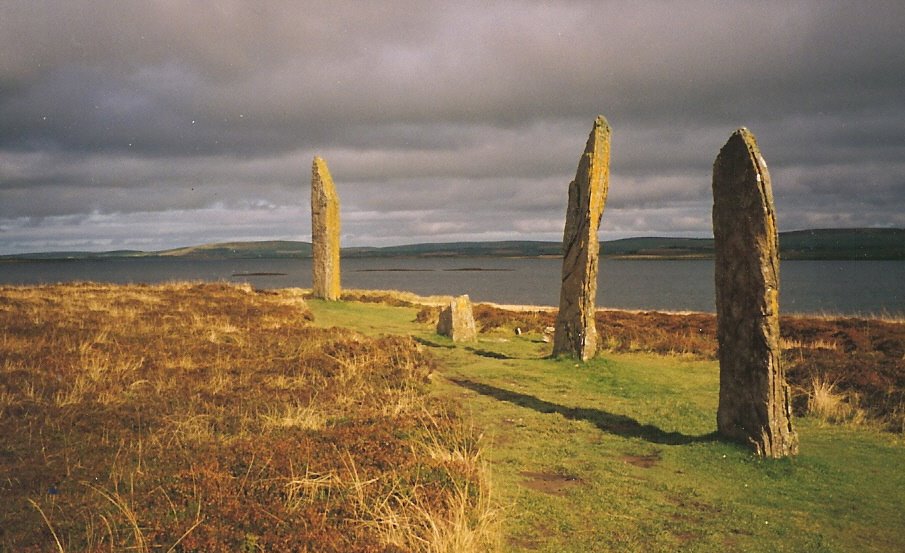

 Orkney view, near Kirkwall
 Ring of Brodgar, Standing Stones, Orkney